
IEC 61850 has become the global standard for substation communication systems, enabling interoperability between protection relays, bay controllers, SCADA systems, and engineering tools.
At the heart of IEC 61850 client/server communication is MMS (Manufacturing Message Specification)—and one of the most searched questions is:
What port number does IEC 61850 MMS use?
This article provides a complete explanation of the IEC 61850 MMS port number, how it works, and how it is used in real substations.
Table of Contents
What Is MMS in IEC 61850?
MMS (Manufacturing Message Specification) is the protocol used by IEC 61850 for client/server services, such as:
- Reading measurements and status values
- Sending control commands (open/close breakers)
- Receiving reports and logs
- Browsing logical devices and logical nodes
- Engineering access and configuration
MMS is defined in IEC 61850-8-1, which maps the IEC 61850 abstract services to MMS over Ethernet networks .
IEC 61850 MMS Port Number (Official Answer)
IEC 61850 MMS uses TCP port 102
| Parameter | Value |
|---|---|
| Transport protocol | TCP |
| Port number | 102 |
| Communication model | Client / Server |
| IEC standard | IEC 61850-8-1 |
This means:
- IEDs (servers) listen on TCP port 102
- Clients (SCADA, gateways, engineering tools) initiate connections to TCP port 102
The port number 102 is standardized and mandatory.
Why Does IEC 61850 MMS Use Port 102?
Port 102 originates from the ISO-on-TCP (RFC 1006) communication model used by MMS long before IEC 61850 existed.
IEC 61850 deliberately retained:
- The same MMS application layer
- The same TCP transport
- The same well-known port number
This guarantees:
- Multi-vendor interoperability
- Predictable firewall configuration
- Compatibility with legacy and modern systems
In most IEDs, the MMS port cannot be changed.
IEC 61850 MMS vs GOOSE vs Sampled Values (Ports Compared)
A very common source of confusion is mixing MMS with other IEC 61850 services.
| IEC 61850 Service | Transport | Port |
|---|---|---|
| MMS | TCP/IP | 102 |
| GOOSE | Ethernet Layer 2 | ❌ No TCP/UDP |
| Sampled Values (SV) | Ethernet Layer 2 | ❌ No TCP/UDP |
| PTP / SNTP | UDP/IP | 319 / 320 (PTP), 123 (SNTP) |
Only MMS uses TCP port 102.
What Data Is Carried Over MMS (Port 102)?
MMS over TCP 102 carries non-time-critical but essential substation data, including:
- Measured values (currents, voltages, power)
- Status information (breaker position, alarms)
- Control commands (operate, select, cancel)
- Reports (buffered and unbuffered)
- Logs and event records
- File transfer and configuration access
Fast protection signals are not sent via MMS—they use GOOSE or SV instead.
IEC 61850 MMS Communication Stack (Simplified)
According to IEC 61850-8-1, MMS communication follows this stack :
Application     → MMS (ISO 9506)
Presentation    → ASN.1 / BER
Session         → OSI Session
Transport       → TCP
Network         → IP
Data Link       → Ethernet (IEEE 802.3)
Physical        → Copper / Fiber
This stack explains why TCP port 102 is always present when MMS is used.
How to Identify MMS Port 102 in Wireshark
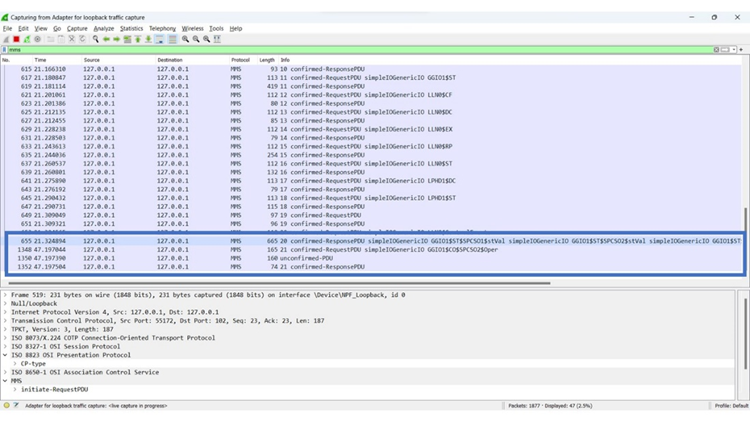
During testing or troubleshooting, MMS traffic is easy to detect.
Useful Wireshark display filters:
tcp.port == 102
or
mms
You will typically see:
- TCP handshake (SYN, SYN-ACK, ACK)
- MMS Initiate Request / Response
- Read, Write, Report, and Control services
If TCP 102 is blocked, SCADA communication will fail.
Firewall Rules for IEC 61850 MMS
From a cybersecurity and network-design perspective:
Best practices:
- Allow TCP port 102 only between trusted devices
- Restrict access to known SCADA and IED IP addresses
- Segment MMS traffic using VLANs
- Apply IEC 62351 security measures when possible
- Never expose TCP 102 to public or corporate IT networks
Where MMS Fits in a Digital Substation
MMS typically connects:
- SCADA ↔ Protection relays
- SCADA ↔ Bay controllers
- Engineering tools ↔ IEDs
- Gateways ↔ Control centers
It forms the backbone of visibility and control in IEC 61850 systems.
Conclusion
IEC 61850 MMS relies on TCP port 102 as its standardized and mandatory communication channel for client/server services in digital substations. This port enables essential functions such as monitoring, control, reporting, and engineering access between SCADA systems and IEDs.
Understanding that MMS always uses TCP 102—and how it differs from GOOSE and Sampled Values—helps engineers design reliable networks, configure firewalls correctly, and troubleshoot communication issues efficiently. In short, TCP port 102 is a foundational element of IEC 61850 interoperability and everyday substation operation.