
Ethernet is the backbone of modern substation automation. Protection relays, bay controllers, merging units, and SCADA gateways all communicate over Ethernet networks carrying time-critical GOOSE messages, Sampled Values, and MMS traffic.
But substations are among the harshest environments for communication equipment. High electromagnetic interference, wide temperature swings, vibration, and electrical transients are the norm. A commercial office switch will fail within months — if it survives installation at all.
An IEC 61850-3 Ethernet switch is built specifically for this environment. The standard defines the environmental, electrical, EMC, mechanical, and safety requirements that communication devices must meet to operate reliably in substations and power plants.
However, IEC 61850-3 compliance alone is not enough. A substation switch also needs the right networking features: VLANs for traffic isolation, QoS for priority handling, PTP for time synchronization, multicast filtering for GOOSE and Sampled Values, and cybersecurity features per IEC 62351.
This guide covers everything — from hardware compliance to network configuration — so you can specify, evaluate, and deploy the right switch for your IEC 61850 substation.
Table of Contents
1. What Is an IEC 61850-3 Ethernet Switch
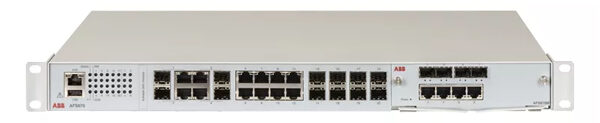
An IEC 61850-3 Ethernet switch is a substation-grade networking device that meets the requirements defined in IEC 61850-3:2013 (current edition) for communication and automation equipment used in power utility environments.
IEC 61850-3 defines general requirements — not protocol specifications. It covers how the device must perform under the environmental, electrical, and electromagnetic conditions found in substations and power plants.
For utilities and system integrators, IEC 61850-3 compliance is typically a mandatory tender requirement. For manufacturers, it is the benchmark that separates substation-grade equipment from generic industrial hardware.
2. IEC 61850 Compatible vs IEC 61850-3 Compliant
This distinction is critical and frequently misunderstood:
| Term | Meaning |
|---|---|
| IEC 61850 compatible | The switch can transport IEC 61850 protocols (MMS, GOOSE, Sampled Values). Any managed Ethernet switch can do this. |
| IEC 61850-3 compliant | The switch meets the construction, environmental, EMC, and safety requirements for substation installation. This requires testing and certification. |
Many switches can forward IEC 61850 traffic. Only switches tested and certified to IEC 61850-3 are suitable for long-term deployment in substations. Always verify with an accredited test report — not just a marketing claim.
3. Environmental Requirements
Operating Temperature
One of the most visible differences from commercial switches. IEC 61850-3 defines normal operating conditions of –10 °C to +55 °C. Extended ranges of –40 °C to +70 °C are common when agreed between manufacturer and user.
This ensures operation in unconditioned relay rooms, outdoor enclosures, and extreme climates.
Humidity
Relative humidity up to 95% (24-hour average) under normal conditions, with no condensation or ice formation. Switch design must include conformal PCB coatings, corrosion-resistant materials, and ventilation that prevents moisture buildup.
Altitude
Installation up to 2,000 m above sea level without derating. At higher altitudes, insulation coordination and cooling performance must be reviewed.
Pollution Degree
Ethernet switches for substations must tolerate pollution degree 2 or 3 depending on installation conditions. This affects creepage distances, enclosure design, and material selection.
4. Power Supply and Electrical Ratings
Auxiliary Power
Substations use DC battery systems. IEC 61850-3 allows both AC and DC auxiliary supplies:
| Voltage Type | Common Values |
|---|---|
| DC | 24V, 48V, 110V, 125V, 220V |
| AC | 110V, 230V |
The operating range is 80% to 110% of rated voltage, ensuring continued operation during battery discharge, charger ripple, and temporary voltage deviations.
Redundant Power
Most IEC 61850-3 switches support dual redundant power inputs. If one supply fails, the switch continues operating on the second supply without interruption. This is essential for substations where a single power failure must not take down the communication network.
Power Burden
Manufacturers must specify power consumption at quiescent and maximum load, and inrush current at startup. System designers need this to size auxiliary power systems correctly.
5. EMC and Electrical Immunity
Why EMC Is Critical
Switching operations, fault currents, lightning strikes, and high-voltage equipment generate electromagnetic disturbances that can disrupt communication equipment. IEC 61850-3 aligns switch EMC requirements with those used for protection relays.
Immunity Tests
IEC 61850-3 references a comprehensive set of tests:
| Test | Standard | What It Simulates |
|---|---|---|
| Electrostatic Discharge (ESD) | IEC 61000-4-2 | Personnel touching equipment |
| Electrical Fast Transients (EFT/Burst) | IEC 61000-4-4 | Switching transients on power lines |
| Surge Immunity | IEC 61000-4-5 | Lightning-induced surges |
| Radiated RF Immunity | IEC 61000-4-3 | Radio transmitters near the substation |
| Conducted RF Immunity | IEC 61000-4-6 | RF coupled into cables |
| Power Frequency Magnetic Fields | IEC 61000-4-8 | 50/60 Hz fields from busbars and cables |
The switch must continue operating correctly during and after these disturbances — no packet loss, no reboot, no configuration loss.
Emissions
The switch must also meet emission limits to avoid interfering with sensitive protection and measurement equipment in the substation.
6. Mechanical, Climatic, and Seismic Performance
Vibration and Shock
Substations experience vibration from nearby machinery, switching operations, and seismic activity. IEC 61850-3 references vibration and shock tests derived from relay standards.
Seismic Requirements
In seismically active regions, switches may need to meet higher severity classes. This influences mounting methods, chassis rigidity, and connector retention.
Enclosure and Mounting
Most IEC 61850-3 switches are designed for rack-mount (19-inch) or DIN-rail installation in relay cabinets. Fanless designs are preferred for long-term reliability and dust resistance in substation environments.
7. Communication Performance During Tests
This is often overlooked but critical: communication must be maintained during EMC and environmental testing.
During all IEC 61850-3 tests, the switch must:
- Continue forwarding Ethernet frames correctly
- Not reset or lose configuration
- Maintain packet loss within acceptable limits
For protection applications using GOOSE or Sampled Values, even a brief communication interruption can cause a protection failure. IEC 61850-3 treats Ethernet switches as active participants in the protection system — not passive infrastructure.
8. IEC 61850-3 vs IEEE 1613
Many switches are certified to both standards. While similar, there are differences:
| Aspect | IEC 61850-3 | IEEE 1613 |
|---|---|---|
| Geography | Global (IEC standard) | Primarily North America |
| EMC alignment | IEC 61000 series | IEEE/ANSI test methods |
| Temperature classes | Defined by agreement | Class 1 (0–50°C) and Class 2 (–40 to +70°C) |
| Seismic | Referenced from IEC standards | Defined within IEEE 1613 |
Utilities often specify compliance with both standards to ensure global applicability and maximum robustness. Always verify with actual test reports from accredited laboratories.
9. VLAN Configuration Requirements
VLAN configuration is not optional in IEC 61850 substations. IEC 61850-8-1 requires GOOSE and Sampled Values to use VLAN tagging for traffic isolation and priority.
Why VLANs Are Required
GOOSE and SV are Layer 2 multicast frames. Without VLANs, every GOOSE message floods every port on the switch — wasting bandwidth, increasing latency, and creating a security risk.
Recommended VLAN Design
| VLAN | Traffic Type | Typical VLAN ID | 802.1p Priority |
|---|---|---|---|
| Station Bus | MMS (SCADA polling, control) | 100 | 2–3 |
| GOOSE Bus | GOOSE protection messages | 200 | 4 (or 7 for critical) |
| Process Bus | Sampled Values | 300 | 4–6 |
| Time Sync | IEEE 1588 PTP | 400 | 5–7 |
| Management | Switch management, SNMP, engineering | 10 | 0–1 |
Switch Requirements for VLANs
- IEEE 802.1Q VLAN tagging — assign, tag, and filter VLANs per port
- Trunk ports (carry multiple VLANs between switches) and access ports (single VLAN to IEDs)
- IEEE 802.1p priority tagging in the VLAN header
- Minimum 256 VLANs supported
- VLAN-based multicast filtering — GOOSE frames must stay within their VLAN
⚠️ Critical: GOOSE and SV traffic must never share a VLAN with MMS or management traffic. A burst of MMS file transfers can delay GOOSE messages beyond the 4 ms protection requirement.
10. GOOSE and Sampled Values Multicast Handling
GOOSE and SV are multicast frames. The switch must handle them efficiently to meet the sub-4 ms timing requirements for protection.
Key Features Required
| Feature | Why It Matters |
|---|---|
| IGMP Snooping | Prevents multicast flooding. The switch learns which ports need which multicast groups and only forwards to subscribing ports. |
| Static multicast filtering | Manual configuration of multicast forwarding. More deterministic than IGMP. Recommended for critical GOOSE traffic. |
| Storm control | Limits broadcast/multicast rates per port. Prevents a misbehaving IED from flooding the network. |
| Multicast group capacity | Minimum 256 groups. Large substations may need 512+. |
IGMP Snooping vs Static Multicast
For MMS and non-critical traffic, IGMP snooping works well — it dynamically learns which ports need multicast traffic.
For GOOSE protection traffic, use static multicast entries configured manually. This eliminates any learning delay and ensures deterministic forwarding from the first frame. IEC TR 61850-90-4 recommends static configuration for time-critical multicast.
11. IEEE 1588v2 PTP Time Synchronization
Accurate time synchronization is essential for timestamped events, sequence-of-events recording, and Sampled Values alignment. IEC 61850 substations use IEEE 1588v2 Precision Time Protocol (PTP).
Switch Role in PTP
The switch is not just a passive forwarder — it actively participates in PTP by compensating for its own forwarding delay.
| PTP Mode | Description | When to Use |
|---|---|---|
| Transparent Clock (TC) | Measures its own residence time and adds it to the PTP correction field. Does not modify the clock hierarchy. | Most common. Recommended by IEC TR 61850-90-4. |
| Boundary Clock (BC) | Runs its own PTP clock. Acts as slave on upstream port and master on downstream ports. | Used when the network has multiple segments. |
Power Profile
IEC 61850 substations use the IEEE C37.238 Power Profile (or IEC/IEEE 61850-9-3:2016):
- PTP over Layer 2 Ethernet (not UDP)
- Peer-to-peer delay mechanism (P2P)
- 1 PPS output for IRIG-B synchronization
- Target accuracy: ±1 µs end-to-end
Switch Requirements for PTP
- Hardware timestamping at the PHY or MAC level. Software timestamping is not accurate enough.
- Transparent Clock or Boundary Clock per the Power Profile
- Low and deterministic jitter — the switch must not introduce variable delay to PTP frames
- PTP over VLAN — must support PTP within tagged VLANs
💡 Pro Tip: Ask the vendor for PTP accuracy measured port-to-port through the switch. A switch adding more than 100 ns of jitter per hop will degrade timing in large networks.
12. QoS and Priority Queuing
Quality of Service ensures that time-critical GOOSE and SV frames are forwarded before MMS and management traffic.
How It Works
Each frame carries a 3-bit IEEE 802.1p priority value (0–7) in the VLAN tag. The switch maps these priorities to internal hardware queues and forwards higher-priority queues first.
Recommended Priority Mapping
| Priority | Traffic Type | Scheduling |
|---|---|---|
| 7 | PTP synchronization | Strict Priority |
| 6 | Sampled Values | Strict Priority |
| 4 | GOOSE (protection) | Strict Priority |
| 3 | MMS (SCADA) | Weighted Round Robin |
| 2 | Engineering access | WRR |
| 0–1 | Management, background | Best effort |
Switch Requirements for QoS
- Minimum 4 hardware queues per port (8 preferred to match 802.1p levels)
- Strict Priority (SP) scheduling for the highest queues
- Weighted Round Robin (WRR) for lower queues to prevent starvation
- Queue depth monitoring to detect congestion
⚠️ Warning: Without QoS, the switch treats all frames equally. A 10 MB file download over MMS will queue hundreds of frames ahead of a single GOOSE trip command. The result: GOOSE arrives late, and the protection scheme fails to operate within its required time.
13. Latency and Performance (IEC TR 61850-90-4)
IEC TR 61850-90-4:2020 (Edition 2) is the technical report that provides network engineering guidelines for IEC 61850 substations, including recommended switch features, topology options, redundancy strategies, and clock synchronization. It was significantly revised in 2020 with a new object model for bridges and clocks.
For wide-area network (WAN) engineering, the companion document IEC TR 61850-90-12:2020 covers substation-to-substation and substation-to-control-centre communication.
Key Performance Metrics
| Metric | Requirement | Notes |
|---|---|---|
| Forwarding latency | < 10 µs (cut-through) or < 30 µs (store-and-forward) | For GOOSE and SV |
| Non-blocking architecture | Full wire-speed on all ports simultaneously | No port slows down because others are busy |
| Frame loss | 0% under normal and EMC conditions | Any loss on GOOSE/SV is a protection risk |
| MAC address table | ≥ 8K entries | Large substations with many IEDs |
| Multicast groups | ≥ 256 | One per GOOSE/SV dataset |
| VLAN support | ≥ 256 | Station bus, process bus, management, per-bay VLANs |
Store-and-Forward vs Cut-Through
- Store-and-forward: Receives the entire frame, checks CRC, then forwards. Higher latency (5–30 µs) but catches corrupted frames.
- Cut-through: Starts forwarding after reading the destination MAC (2–5 µs latency). Faster but forwards corrupted frames.
For most IEC 61850 substations, store-and-forward is preferred because frame integrity matters more than a few microseconds. Cut-through can be used on process bus segments where SV latency is most critical.
14. Network Redundancy: PRP and HSR
IEC 61850-3 does not define redundancy protocols, but substation switches must support the architectures used in practice.
PRP — Parallel Redundancy Protocol (IEC 62439-3)
- The IED connects to two independent networks via two Ethernet ports.
- Every frame is sent on both networks simultaneously.
- The receiver accepts the first copy and discards the duplicate.
- Seamless redundancy — no frame loss during a single network fault.
- Requires a RedBox (Redundancy Box) for single-port devices.
HSR — High-availability Seamless Redundancy (IEC 62439-3)
- Devices are connected in a ring topology — no switches needed between nodes.
- Each frame is sent in both directions around the ring.
- The destination accepts whichever copy arrives first.
- Zero recovery time — the ring continues operating even with one broken link.
- Requires hardware support (FPGA) in each node for cut-through forwarding.
RSTP — Rapid Spanning Tree Protocol
- Recovery time: hundreds of milliseconds (too slow for protection GOOSE).
- Acceptable only for non-critical traffic (MMS monitoring, engineering access).
- Not suitable for protection-grade GOOSE or Sampled Values.
Switch Requirements
- PRP RedBox support if the switch serves as the redundancy interface for single-port IEDs
- HSR RedBox if connecting HSR ring nodes to a PRP or standard Ethernet network
- RSTP/ERPS as fallback for non-critical segments
15. Port Security and Cybersecurity
Following IEC 62351 (data and communications security) and IEC 62443 (industrial automation security), substation switches should include:
| Feature | Purpose |
|---|---|
| IEEE 802.1X | Port-based authentication — only authenticated devices connect |
| MAC address filtering | Restrict which MAC addresses are allowed per port |
| ACLs | Filter by MAC, IP, VLAN, EtherType, or protocol |
| Port disable | Administratively disable unused ports |
| MACsec (802.1AE) | Layer 2 encryption — aligns with IEC 62351 |
| SNMPv3 | Encrypted management — avoid SNMPv1/v2c clear-text credentials |
| Syslog | Forward security events to a central log server |
| Port mirroring | Mirror traffic for IDS or Wireshark analysis |
16. Common Mistakes When Selecting Switches
| Mistake | Consequence | Fix |
|---|---|---|
| Confusing IEC 61850 compatible with IEC 61850-3 compliant | Switch fails in substation environment | Verify with accredited test report |
| Using IT-style power supplies | Premature failure from DC supply or voltage range | Specify DC power matching substation auxiliary supply |
| No VLAN configuration | GOOSE floods all ports, protection latency increases | Configure dedicated VLANs per traffic type |
| QoS disabled or not configured | MMS traffic delays GOOSE messages | Enable Strict Priority for GOOSE/SV queues |
| Software PTP timestamping | Time accuracy degrades across multiple hops | Require hardware PTP timestamping |
| RSTP used for protection GOOSE | Hundreds of ms recovery time — protection failure risk | Use PRP or HSR for protection traffic |
| Self-declaration without test reports | Non-compliant installation discovered during commissioning | Require accredited lab test reports in tender |
17. IEC 61850-3 Switch Selection Checklist
Use this when writing specifications or evaluating vendor bids.
Environmental & Hardware:
- IEC 61850-3 and/or IEEE 1613 certified (accredited test report required)
- Operating temperature range meets site requirements (–40 °C to +70 °C for extreme sites)
- DC power input matching substation auxiliary supply (48V, 110V, or 220V DC)
- Redundant power inputs
- Fanless design
- Rack-mount (19-inch) or DIN-rail form factor
Network Performance:
- Non-blocking, wire-speed forwarding on all ports
- Forwarding latency < 10 µs (cut-through) or < 30 µs (store-and-forward)
- MAC address table ≥ 8K entries
- Multicast group support ≥ 256
- Gigabit Ethernet on all ports (copper + SFP fiber)
VLAN & QoS:
- IEEE 802.1Q VLAN support (≥ 256 VLANs)
- IEEE 802.1p priority tagging with ≥ 4 hardware queues per port (8 preferred)
- Strict Priority scheduling for GOOSE/SV queues
- IGMP snooping and static multicast filtering
- Storm control per port
Redundancy:
- PRP support (IEC 62439-3) — RedBox if needed
- HSR support (IEC 62439-3) — if used in ring topology
- RSTP/ERPS for non-critical segments
Time Synchronization:
- IEEE 1588v2 PTP with hardware timestamping
- Transparent Clock and/or Boundary Clock
- Power Profile (IEEE C37.238 / IEC/IEEE 61850-9-3:2016) support
- PTP over tagged VLANs
Security:
- IEEE 802.1X port-based authentication
- MAC address filtering per port
- ACLs (Layer 2 / Layer 3)
- Port disable capability
- MACsec (802.1AE) support
- SNMPv3 for encrypted management
- Syslog for event logging
- Port mirroring for IDS integration
Management & Diagnostics:
- Web GUI and CLI access
- SNMP v2c/v3 with MIB-II
- Port mirroring (SPAN)
- Loop protection
- Configuration backup and restore
- Firmware upgrade capability
18. Typical Applications in Digital Substations
IEC 61850-3 Ethernet switches are deployed in:
- Station bus networks — connecting protection relays, bay controllers, and SCADA gateways over MMS
- Process bus architectures — carrying Sampled Values from merging units to protection IEDs
- GOOSE networks — transporting time-critical protection and interlocking signals between IEDs
- Inter-bay communication — linking bays within a substation for distributed protection schemes
- Engineering and maintenance access — providing network access for configuration tools and diagnostics
- Redundancy infrastructure — serving as PRP RedBox or HSR-to-PRP bridge
- Virtualized Protection and Control (vPAC) — a growing trend where protection and control functions run on IEC 61850-3 certified servers instead of dedicated IEDs. The switch becomes even more critical in vPAC architectures because all protection traffic flows through the network.
Their role is foundational. A single switch failure or misconfiguration can disable protection functions across an entire substation. That is why IEC 61850-3 compliance, proper network configuration, and cybersecurity are all non-negotiable.
Summary
An IEC 61850-3 Ethernet switch is not just a network component — it is a critical element of the power system protection infrastructure.
Hardware compliance (IEC 61850-3 / IEEE 1613) ensures the switch survives the substation environment. But that is only half the requirement.
Network features — VLANs, QoS, PTP, multicast handling, PRP/HSR, and cybersecurity — determine whether the switch actually delivers the performance that GOOSE, Sampled Values, and MMS need.
When specifying a switch, cover both sides. Use the selection checklist. Require accredited test reports for environmental compliance. And always configure VLANs, QoS, and security before commissioning — a switch with default settings is a switch waiting to cause problems.