
SCADA (Supervisory Control and Data Acquisition) is the core technology used to monitor, control, and optimize industrial processes across large-scale infrastructures such as power systems, oil & gas pipelines, water networks, and manufacturing plants.
In practical engineering terms, SCADA is the integration of:
- Field data acquisition
- Reliable communication systems
- Centralized supervision and control
It allows operators to see, analyze, and act on real-time data, ensuring operational efficiency, safety, and reliability.
In modern systems, SCADA is no longer just a monitoring tool—it is a mission-critical control platform tightly integrated with automation, networking, and IT systems.
1. SCADA System Architecture (End-to-End View)
A SCADA system follows a layered architecture, designed for scalability, reliability, and interoperability.
1.1 Field Layer (Instrumentation Level)
This is where physical measurements are taken.
Typical devices:
- Voltage transformers (VT)
- Current transformers (CT)
- Pressure, flow, temperature sensors
- Position switches and breakers
Signal types:
- Analog
- Digital: Binary status (ON/OFF)
Engineering note:
Signal integrity and grounding at this level directly impact SCADA accuracy.
1.2 Control Layer (RTU / PLC / IED)
This layer acts as the interface between physical process and digital system.
RTU (Remote Terminal Unit)
- Designed for remote environments
- Supports:
- Multi-protocol communication
- Time-stamped events
- Low power operation
PLC (Programmable Logic Controller)
- Used for:
- High-speed control
- Sequential logic
IED (Intelligent Electronic Device)
- Combines:
- Protection
- Control
- Communication
Modern substations rely heavily on IEDs for IEC 61850-based automation
According to SCADA system design principles, these devices collect and transmit field data to the master station for processing .
1.3 Communication Layer
This is the most critical layer in SCADA performance.
Communication Media:
- Fiber optics (preferred for substations)
- Ethernet (LAN/WAN)
- Radio / microwave
- Cellular (4G/5G)
- Satellite (remote sites)
Protocols:
- Modbus (legacy/simple)
- DNP3 (robust SCADA)
- IEC 60870-5-104 (Europe standard)
- IEC 61850 (substation automation)
Key Engineering Requirements:
- Latency < 10 ms (protection)
- Deterministic delivery
- High availability (99.99%)
1.4 SCADA Master Station
The central brain of the system.
Functions:
- Data acquisition from RTUs
- Alarm processing
- Event logging
- Control command dispatch
Typical architecture:
- Redundant servers (hot standby)
- Historian database
- Application servers
1.5 HMI (Human-Machine Interface)
The visual interface for operators.
Features:
- Single Line Diagrams (SLD)
- Real-time values
- Alarm panels
- Trend curves
Good HMI design reduces operator error significantly.
1.6 Enterprise Integration Layer
SCADA integrates with:
- EMS (Energy Management System)
- DMS (Distribution Management System)
- ERP systems
2. How SCADA Works (Real Process Flow)
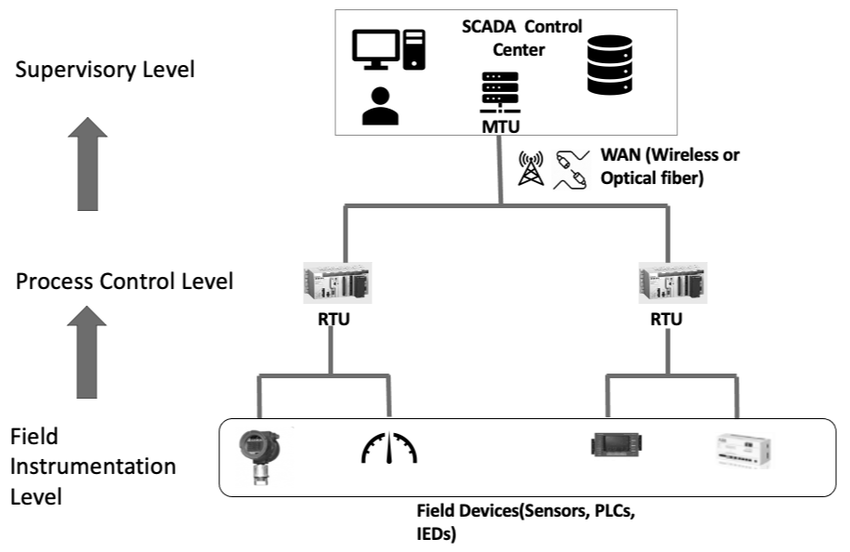
Step-by-step operation:
Step 1: Measurement
Sensors capture real-world values:
Voltage = 225 kV
Current = 1200 A
Step 2: Data Acquisition
RTU/PLC:
- Converts analog → digital
- Applies scaling:
Engineering value = (Raw × Scale) + Offset
Step 3: Data Transmission
Data sent via:
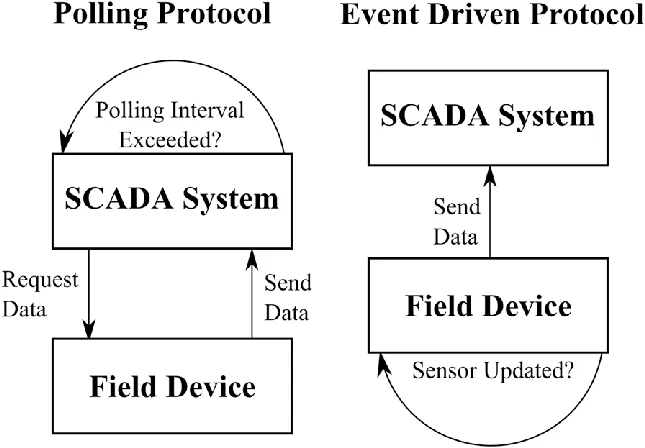
- Polling (master-slave)
- Event-driven (report by exception)
Step 4: Processing
SCADA server:
- Stores data
- Evaluates alarms
- Executes logic
Step 5: Visualization
Operator sees:
- Real-time dashboard
- Alarms
- Trends
Step 6: Control Action
Example:
- Open breaker
- Start pump
3. SCADA Communication Fundamentals
3.1 OSI Model in SCADA
SCADA communication is structured based on layered models.
Key layers used:
- Physical (RS-485, Ethernet)
- Data Link (frame handling)
- Application (protocol logic)
Industrial protocols typically use a reduced OSI model
3.2 TCP/IP in SCADA
Modern SCADA systems rely on TCP/IP:
TCP:
- Reliable
- Used in:
- IEC 104
- Modbus TCP
UDP:
- Fast
- Used in:
3.3 Communication Architectures
- Point-to-point
- Star topology
- Ring (redundant)
- Mesh networks
4. Types of SCADA Systems
4.1 Monolithic SCADA
- Centralized
- Legacy systems
4.2 Distributed SCADA
- Multiple control nodes
- Increased reliability
4.3 Networked SCADA (Modern)
- Based on:
- Ethernet
- Cloud integration
- Supports:
- Remote monitoring
- IoT devices
5. SCADA Protocols Explained
5.1 DNP3
- Event-driven
- Time synchronization
- High reliability
5.2 IEC 60870-5-104
- TCP/IP based
- Widely used in Europe
5.3 IEC 61850
- Object-oriented model
- High-speed communication
- GOOSE & SV messaging
6. SCADA vs PLC vs DCS
| Feature | SCADA | PLC | DCS |
|---|---|---|---|
| Scope | Wide area | Machine | Plant |
| Speed | Medium | Very fast | Fast |
| Function | Supervision | Control | Process |
7. Real Industrial Applications
Power Systems
- Substation automation
- Load dispatch
Water Systems
- Pump stations
- Reservoir control
Oil & Gas
- Pipeline SCADA
- Leak detection
Manufacturing
- Production monitoring
8. Advantages of SCADA
- Centralized monitoring
- Remote control
- Improved efficiency
- Real-time visibility
- Reduced downtime
SCADA can monitor thousands of distributed sensors efficiently
9. Challenges and Limitations
- System complexity
- Communication dependency
- Cybersecurity risks
- Skilled workforce required
10. SCADA Cybersecurity
Threats:
- Malware
- Unauthorized access
- Network attacks
Standards:
- IEC 62443
- NIST
Best Practices:
- Network segmentation
- Firewalls
- Monitoring systems
11. SCADA Design Best Practices (Field-Proven)
1. Redundancy
- Dual servers
- Dual communication paths
2. Time Synchronization
- NTP/PTP
3. Network Segmentation
- IT vs OT separation
4. Protocol Selection
- IEC 61850 → substations
- DNP3 → utilities
- Modbus → simple systems
12. Future of SCADA
- Digital substations
- AI-based analytics
- Cloud SCADA
- Edge computing
Conclusion
SCADA is the foundation of industrial automation, enabling real-time monitoring and control of critical infrastructure.
A properly engineered SCADA system ensures:
- Reliability
- Safety
- Operational efficiency
The future of SCADA lies in its integration with:
- Smart grids
- Industrial IoT
- Advanced analytics